Wednesday, November 9, 2011

Ancient Illustration

Before movable type, wood cuts were difficult to make, 
but easy to mass produce. See the detail in this carving? 
Unfortunately, there's no way to correct any mistakes!
After seeing the codices held in special collections, and after trying my hand at calligraphy from the perspective of an illiterate, I have a new appreciation for the effort and time it took to create a single book. 

Now that we are moving on to printed knowledge, I want to explore the illustrative printing processes. Before the advent of movable type, printing consisted of wood cuts and engravings. Wood cuts were very difficult to make, but were very cheap to reproduce. Prints made from wood cuts became very widely circulated in Europe during the thirteenth and fifteenth centuries as paper became more common.


Tuesday, November 8, 2011

Cryptograwhat?

In light of recent news on the BYU Frontpage, there have been many advances, discoveries, and funds put towards hacking, code cracking and holding trade secrets secure. For one, my roommate claims he is very good (or was back in the day) at breaking into any computer he wishes that's attached to a network. This got me thinking, how am I going to secure my computer and my files to best his attempts? Maybe I'll try to secure my computer and one file and see if he can penetrate it sometime!

As Kacee was saying yesterday, people have been the same over generations of time with typically the same worries. Although earlier people weren't trying to secure terabytes of data, they may have been protecting valuable secrets. Things of value that should not be disclosed to a select group whom the author chooses, he wishes  to barricade his knowledge against their learning. Thus cryptography is born!

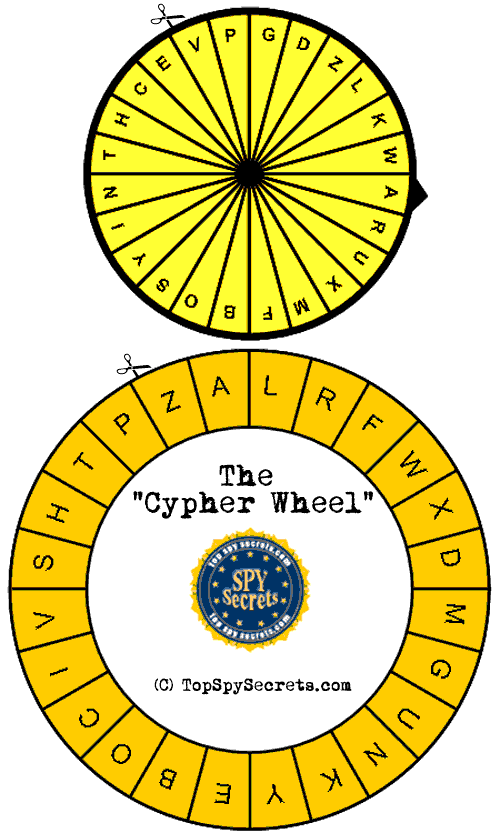
Code your own message with a simple
pinwheel (from here).
What is Cryptography? The word actually is greek for "hidden"+"writing" or "study" and we do have ancient examples of the Greeks using coded messages. It's medium is anything written and in it's basic form, it means to translate a message in a way that the message is unreadable to anyone but the intended reader who must translate into the original. Cryptography can be simple, such as a pinwheel with a principle letter or "key" that all the other letters align with, then the code can be decrypted. It can be something similar to the Caesar Shift as Caesar in order to communicate with his generals would code his messages so that each letter in the message was shifted down the alphabet a set amount. He shifted by three.

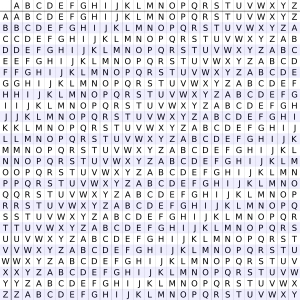
 It can also be mind numbingly difficult like the Vigenere square, invented by Leon Baptist Alberti (who I learned about in my Italian History class as the first "Renaissance Man"). Here, a Caesar shift is written down in a matrix so that each column represents the alphabet shifted a certain number of times. The coder chooses a message (e.g. "attackatdawn"), and a key word (e.g. "lemon"). The key is repeated until it is the same length as the plain text ("lemonlemonle"). From there you just take one letter at a time from the message and the key (L from the key, A from the message) and match the "L" row with the "A" column to get your first code letter (coincidentally and L!). When you're done your message will be LXFOPVEFRNHR. It's pretty hard to crack that!!!
Vigenere Square

An ancient Greek Skytale. This little instrument would have
you wrap your message in such a way that the lines matched
up. When literacy was uncommon, simple methods such as
this were adequate means of coding.
How do you determine how much time and effort to put into a code ? I could jumble the words of a message all day, but how tough does it need to be to crack? This question may be solved by considering what the task is. Let's say we're are roman soldiers back in the 3rd century AD stationed in Brittania with knowledge of a mutiny army bent towards Italy. We wish to relay our knowledge to Rome but without the perpetrating general's knowledge. The message needs to be coded well enough that the messenger, should he be caught and questioned along his 1100 mile journey that nothing be revealed. Maybe the message should be hidden within a routine message that would calm any prying eyes. Armies, Diplomats and Majesties were the principle curators of coded messages for many centuries. However, those under fear of their text calling them out as heretics would eventually join the ranks among the greats of hiding a message within a message. The value of written knowledge is amply evident in the extent to which people will go to make it unreadable to all but intended eyes.

Monday, November 7, 2011

Altered Perceptions? Also, Architecture is a Metaphor. But Actually, I think this is a Post about Journals. Maybe. Or maybe I just want you to think. Enlighten me.

I really don't know what happened...

I'm always so stuffy in my blogposts. In my attempts to sound scholarly or academic or professional or whatever it is I try to sound like in my blogposts, I sometimes lose myself. No, I almost always lose myself. I could even say I always lose myself. This is a tragedy.

So what does this have to do with written knowledge, architecture, or anything worth noting? Well, as I was contemplating how to write this blogpost, I got thinking about all the different voices we use in writing. There's our personal voice, our formal voice, our persuasive voice, our objective voice -- so many voices! Then comes the editing. Think of how much we edit our thoughts as we create the final product (Even as I attempt to type this I'm editing like crazy, and I was trying so hard to just speak my mind!).


Friday, November 4, 2011

A Brief Look at the Number Systems and Mathematics of Mesopatamia


So if Assyria had its own number system, it was not important enough for anyone to write about.  As it stands, most the information about Mesopotamian number systems is about Babylonian's system, with only  a little knowledge about its predecessor, Akkadian, and Akkadian's predecessor, Sumerian.

A Sumerian List of Amounts of Grain

Wednesday, November 2, 2011

Lehi in the Desert

As a child, I learned the Book of Mormon story of the prophet Lehi, who followed a dream to take his family into the deserts surrounding ancient Jerusalem. Now, as a university student, I am finding new depth to the story by reading Hugh Nibley’s book Lehi in the Desert. In this scholarly approach to a religious topic, Nibley explores the so-called “Egypticity” of the story of Lehi by investigating its historical and geographical background. By noting innumerable small coincidences, Nibley points out that The Book of Mormon, first published in 1829, is consistent with our cultural knowledge of Egypt.


Tuesday, November 1, 2011

Movin' Around

Going to San Diego with digital navigators is how
it's done today.
Hey everyone and greetings from San Diego! I'm writing on a bit of 'travel-lag' after 13 hours in a BYU van and little sleep, but the Sun is shining! As I was thinking about this post I wanted to incorporate the usefulness of travel and written knowledge. Today we use "written" (a bit more digital version now) knowledge to get from Provo on I-15 to Las Vegas to San Diego in half a day. The co-pilot (guy in the passenger seat) as soon as he settled in got out his inverter, his laptop, his Garmin GPS and his GPS on his smart phone. It was a mobile command hub in about 45 seconds! We had maps, routes, audio feeds into the speakers on the van so that the little phone gps could have "Ashley" (so the female talking voice is named) tell us the next exit coming up and when we merge where.

Pomponius Mela's Map from AD 43. Notice the
Three Major Continents known at the time arranged
in a circle
So what's the point with all this technology? It facilitates our transportation in a way unprecedented only fifteen years ago. Now let's go back in time to what was around fifteen hundred years ago and earlier. I'm going to use the argument that what stands the test of time is the most valuable to people and the advancement of knowledge. We have more advanced GPS devices and smart phones to tell us more detailed information about maps, navigation and directional knowledge. Cartography, or the making of maps have existed since knowledge was first written. Cave paintings of star charts, landscape drawings to point out land markers, or clay tablets with simple pictures identifying land markers all give evidence to the utilitarian value and significance of maps for early peoples. Maps were based in the past with emphasis on land markers and what oral tradition and experience would pass on.

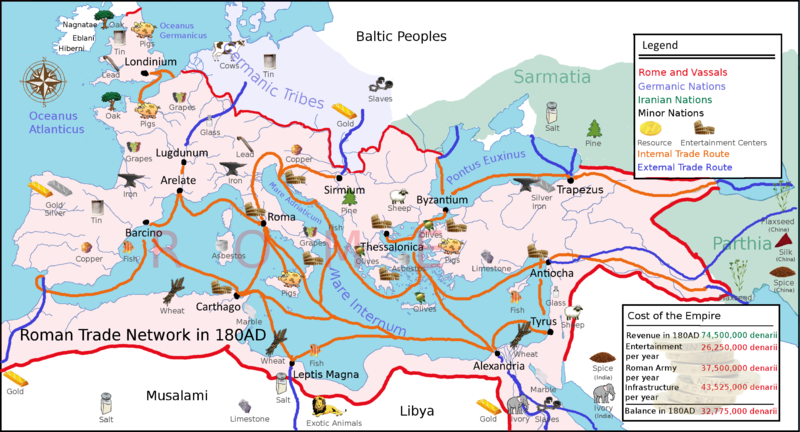
Where a Roman Merchant Might Travel during the 2nd Century AD
Let's take an example, you are a merchant from a small island outside Naples during the height of the Roman Empire. The fact that you are a roman citizen helps you move around easily within the empire so business goes well. Which new route do you wish to try to pick up if it means doubling your money? How do you get there? Traveling can mean traversing fifty miles up the road or thousands of miles across seas. How valuable is someone who can get you there or a map with good directions? What if one of those directions is completely wrong? Jumping back quickly to the present, last night I took the van to a nearby pharmacy to get one of the guys some medicine, but due to a GPS error I took a wrong turn, just in time before the battery went dead. I was practically flying blind on the foggy I-5 interstate trying to get back to the hotel. I knew how important that knowledge was right then! Needless to say I spent an hour learning the nearby roadways and now I'm the most knowledgeable one of the placee. Today's transportation and technology make simple mistakes like this not so costly, but as a Roman merchant I may have wandered into dangerous territory or hazardous terrain. Mistakes were less merciful back then in my opinion. Like Sam's great article on the Polynesian sea-farers, anyone who wishes to move around must have the means of doing so.

Now, was there tourism like there is today? According to Tony Perrottet in a National Geographic article, Augustus was a sort of its founder in the Roman Empire when he created highways and rid the Mediterranean of pirates. The favorite places were the ancient ruins of Troy in Turkey, a place immortalized by Homer's Odessey and Iliad. There was a sense among the more elite class that you weren't cultured until you had been to see where Helen was battled over, seen the great pyramids and the tombs and had these adventurous journeys. It's interesting how writing helped to create a legacy for these areas. In addition to maps, stories were a written knowledge fueling transportation by creating interest in the minds of young and old to go see what they were missing.

Written knowledge incites and motivates us to reach out to the world. It provides us with the means to arrive there by way of maps outlining what we should look for, how long to pack, what to stay clear of and what to expect when we arrive. We have built upon the knowledge of the ancients to advance the industry of transportation and tourism in a way that helps us all see the world and experience life outside of our childhood neighborhoods.

Sunday, October 30, 2011

Q & A with Dr. Toronto: A discussion on Written Knowledge

This past week I was able to interview Dr. James A. Toronto about the significance of written knowledge in the Middle East. Dr. Toronto has a Ph.D from Harvard in Islamic Studies and currently teaches at BYU.