Showing posts with label print knowledge. Show all posts

Wednesday, December 14, 2011

A Medium for Every Nation


                Different forms of media have existed for each generation of Americans today just as for any civilization in history. Some forms of knowledge are more suited to the nation’s size and structure than others in keeping the peace, establishing law and general management. Although multiple forms of media for knowledge exist in a society, the dominant media of that people affects the size and control of governmental power.

Saturday, December 10, 2011

Rosetta project: revisiting history

(Get it? Because I'm just posting this blog now?!)

I participated in part two of the Rosetta project (unit 3 final). It was fascinating!

Tuesday, December 6, 2011

Publishers and Typesettings: The Land that Grows them

North vs South!
So I've been putting the finishing touches on my draft for today's paper (okay it's definitely a draft!) and I have some thoughts that I am excited to use and others that I'm not so sure about, so I could use some feedback. I'll give you a brief road map of my thoughts and then the themes that I am wondering about using.

Friday, December 2, 2011

Persuasive Paper about the Book Trade


The immediate predicament I discovered when presented with this assignment was the question of what I was supposed to argue about?  I chose the very broad topic of publishingand bookselling before 1700 for my annotated bibliography and was unable to foresee a persuasive writing assignment, or I might have chosen a different topic that I could argue about.  For example, if I had print’s effect on the Protestant Reformation, I might argue that it was the deciding factor in the reformation and what enabled change.  Instead I have publishing and bookselling and a dearth of ideas.

Tuesday, November 29, 2011

Against the Current of Change

The Tyndale Bible
What kind of stamina and character would it require to take the most revered, authoritative and regulated book in all of Europe and modify it so that it was in a lower, common everyday language, the same one used by commoners, everyday untaught peasants and servants. This was William Tyndale's work as one of the pioneers to the translation of the Latin Bible into English. What struck me as amazing as I was shuffling slowly through the large display cases filled with different Bible translations was the effort, undying patience and pure boldness required to defy all authority in pursuit of what you believe to be a higher cause. The Exhibit of the King James Bible in the library was quite the collection which showed the history and progression of each Bible into English, usually accompanied by a martyr.

Joseph Smith reading the family Bible
As a brief history, William Tyndale was a very well educated individual, known for his ability to speak languages such as Greek, Hebrew, Latin, Spanish, Italian, and German. He studied at Oxford and during his time he would sputter off his wild opinions in the realms of religion. At one famous encounter John Foxe wrote in Foxe's Book of Martyrs that a man told William, "We had better be without God's laws than the Pope's", to which came the vehement response, "I defy the Pope, and all his law's; and if God spares my life, ere many years, I will cause the boy that driveth the plow to know more of the Scriptures than thou dost!"

Sunday, November 27, 2011

Literature that Relfects Society


As I anticipate completing the bibliography assignment, I find myself reflecting on the time in my life when weekly visits to the library found me bringing home the likes of these books:


Do you remember library day in elementary school? -- That half hour or 45 minutes set aside each week where you traverse the halls in a single file line with your class as you journey to the library in search of a new book? From third grade up, my personal book selections consisted of chapter books. Yours probably did too. But think back to the time before novels. Think back to the time when going to the library meant finding a new picture book. Think back to the time when Curious George, Green Eggs and Ham, and Alexander and the Horrible, Terrible, No Good, Very Bad Day meant more to you than any other reading you did. For me, this was the time when the printed word meant the most to me. This was when reading was exciting!

The history of children's literature greatly reflects and has been profoundly influenced by the history of the printing press. Spanning folk, oral, written, and print knowledge, children's literature is an ever-changing genre that manifests cultural perceptions of childhood.

Friday, November 25, 2011

Bookselling and Publishing

Bookselling and publishing address the main points of the economy of the printed book.  This bibliography lists some books that cover these two topics.

Monday, November 21, 2011

Of Printing Presses and the Publishers who use them...

Knight, Death and the Devil by Durer
I had the opportunity Monday to spend a few hours sitting between the bookshelves of the library and in researching some of the topics I found myself getting lost just taking in all the knowledge around me! In creating my bibliography, the first thing that I learned is that five hundred years is too much time to have only a handful of authoritative sources for research purposes. Many of the books that I perused contained the same information, maybe with an emphasis on one part of the story over another, or explaining how it related to their perspective. I learned to love the fact that books are grouped by subject and finding one good source usually means you've found two or three others next to it on the shelves! This isn't necessarily the case with search engines that return a search based on your input.

Many of the texts that I looked through were surrounded by older sources written in Italian, a point that we have an amazing library at BYU. I served as a missionary in Rome for two years and my Italian definitely was helpful for more than a few of the books that would reference a quote by Aldo Manuzio the way he said it, or even the Latin which I could sort of make out. In all, I actually enjoyed looking through the books and in its own way I felt immersed in the research.

Life and Legacy of the King James Bible


What do hard core drugs, stolen diamonds, and the Bible have in common? Smuggling! That's just one of cool facts I learned when I visited the Life and Legacy of the King James Bible exhibit in the library last Saturday. Besides featuring genuine Bibles dating back to the pre-Renissance era, the exhibit gave a brief history of how the King James version of the Bible came into existence as well as provided an interactive section where vistors could compare different versions of the Bible. Since Catherine's post on the exhibit focused mainly on her experience with examining the fonts of the different Bibles, I wanted to focus my visit (and my post) more on the history of the King James Bible itself and the process through which it came to be. 

The coming about of the King James Bible was an evolutionary process, nearly 1600 years in the making. Its creation stemmed from the desires of  John Wycliffe to provide the Bible to the masses. He wanted the book to be published in more than just Latin. As it contained several "inerrant truths," Wycliffe wanted the common man to be able to acess, read, and understand the Bible (lib.byu.edu). Thus, a miraculous spin of events began which eventually led to the coming forth of the King James Bible.

Friday, November 18, 2011

The Bible Exhibit

I went down to BYU's special collections exhibit "The Life and Legacy of the King James Bible" and noticed some things by looking at the different editions of the Bible.

The font the Bible is printed in has become more legible over time.  This occurred in correlation with the with the Bible being printed.  As more people had access to Bible's and gained the ability to read, the beauty of the Bible became less important than the words themselves.

The shapes of letters has changed over the last 500 years.  We no longer use elongated "s"s which are easy to confuse with "f"s.  Also, "u"s were shaped like "v"s, so the word fun would look like fvn.

The spelling of words became more standard as printed material became more popular.  "The Great Bible," which was handwritten, has the full title "The Byble in Englishe that is the Olde and New Testament, after the translacion appointed to bee read in the churches."  The Geneva Bible published in 1594 contains the message "translated according to the Ebrew and Greeke and conferred with the best translations in diuers languages."  By the time the King James Bible was first printed, most of the spellings of words was more like what we see today.  The full title of the King James Bible is the King James Bible (The Holy Bible containing the Old and New Testaments.

Interesting fact: Robert Barker, who had a monopoly on the printing of the King James Bible, continued to print the Geneva Bible while printing the King James Bible because the Geneva Bible still brought in a lot of revenue.

The printing of the Bible was highly influential, as it led to the average person having greater access to the word of God.  Poets and prose writers was often alluded to the book which continues to be the most read book in the world.

Tuesday, November 15, 2011

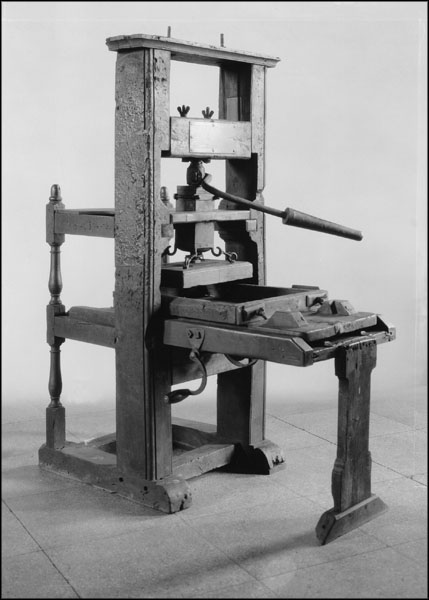
Ink, Sweat and Keeping the Press Moving


"Before printing was discovered, a century was equal to a thousand years." Henry Thoreau
Pauper's Bible - The First Cartoon Strips


Let's start a printing business! We are both venture capitalists with a bit of money and an itch to get into the printing business. What should we print? Who's going to buy and why would they buy it? Well, to start I'd like to mention a few of the types of books that were the "Bestsellers" of the early Renaissance, and maybe then we'll be able to answer these questions.

What were the "Must Reads" of the 1500's?


Nowadays, if you want to know which books are the most popular you can go check a status on the New York Times Bestseller list. However, due to the limited number of books that went into each printing, it was more easy to determine how a book was doing by the number of different editions which were printing. Many editions generally meant that the book was a very popular one. So what were people reading 500 years ago? Well, the obvious one that we can accredit is the Bible, one that has held the title defiantly throughout the Medieval period. The renaissance however gave rise to new tastes and likes. One print of the Bible was the Bibla Paupernum ("Pauper's Bible"), a sort of illustrated text or cartoon strip where more than words were characters talking to one another. Also "Emblem Books" were popular, lessons in book format which seem to be the precursors of the picture book or textbook with pictures and commentary. Andrea Alciato unintentionally started this explosive craze that swept over Europe. He treated his emblems as highly valuable and prefaced his book Emblemata with

Emblem Book Example. What's under the table?


"While boys are entertained by nuts and youths by dice, so playing-cards fill up the time of lazy men. In the festive season we hammer out these emblems, made by the distinguished hand of craftsmen. Just as one affixes trimmings to clothes and badges to hats, so it behooves every one of us to write in silent marks. Though the supreme emperor may give to you, for you to own, precious coins and finest objects of the ancients, I myself shall give, one poet to another, paper gifts: take these, Konrad, the token of my love."

Another popular genre was in the medical field. Books of Secrets as they were called were filled with remedies and cures to all sorts of sicknesses, problems and worries. Translated into almost every European language and in print for well over 200 years, this was the beginning of science in the public eye and a more public or social obligation of the scientist to the community. Reading a bit from the English translation of "Secrets" by Alexis of Piedmont, the author frequently references his remedies to help the sick while holding the value of his "secrets" like a trade secret. I guess everyone likes their secrets!
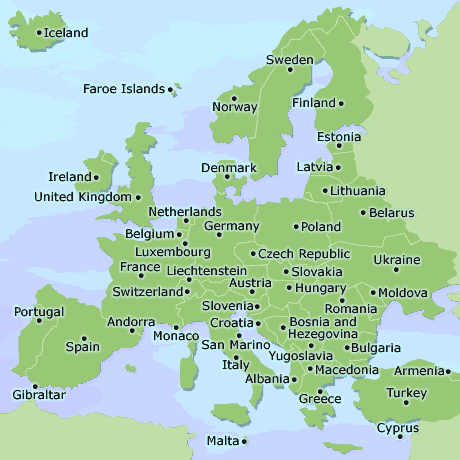
Printing Volume Geographically over first five decades of the press

What were other secrets? Machiavelli's The Prince was a most curious read where a the destined Medici family was to be instructed in the ways of a true leader. Royals and commoners alike enjoyed learning because it was an increase of knowledge. Like the "secrets" of Alexis, most people understood the connection between knowledge and power, thus taking every opportunity to learn about the world they did not understand. It was a sort of reality TV show for the 16th century fanclub!

Other popular books during the 16th century included: Gargantua and Pantegruel by Rabelais, Sir Thomas Moore's Utopia (however I'm not sure if it was popular then), books on European Folklore, The founding myths of Rome.

Suleiman The Magnificent (1530).
As an aside, some Literature didn't catch on, like this fashion. Maybe some day!


One thing is for sure, the influx of published literature from the printing press allowed for the more curious reader, one who could question things, read more and gain knowledge more readily. By only the end of the 15th century, over 20 million copies of printed books were in circulation, with that number growing exponentially by the year.




Monday, November 14, 2011

See No Evil

"Censorship has followed the free expressions of men and women like a shadow throughout history." Mette Neweth
I recently came across the following video:


Given Jimmy Kimmel's compilation of unnecessarily censored videos clips and Catherine's post on newspapers, I've been thinking a lot about censorship lately and wanted to learn more about the subject.

Friday, November 11, 2011

Newspapers


When I was 8 years old, my mom took my siblings and I on a trip around the border of the united states.  We stopped in a lot of states and saw a lot of interesting things.  I remember visiting a print shop that produced newspapers and being in awe of the huge machinery.  Later, when I was in fourth grade, I had the opportunity to stay the night at Sutter's Mill for a field trip.  One of the activities we were able to participate in while we were there was assembling our own newspaper.  Well, only partially.  I was able to assemble the type for my own name for trip, "Clara Greenly" and pick one out of a list of predetermined headlines to have my name inserted into.  Probably the most informative part of the experience was watching how the machinery was operated and the ink applied.  I still have that newspaper in a drawer somewhere back home.