Although digital knowledge has
expanded, and continues to expand, the way the world interacts and gains
information, digital knowledge has not yet replaced print as the dominant form
of knowledge. All of the forms of
knowledge that have dominated the world thus far (folk, oral, written and
print) have encountered a transition period in which a new medium of knowledge
is introduced, but the previous medium remains more influential. Print and digital knowledge are in the middle
of this time of transition.
Showing posts with label Catherine Hawkley. Show all posts
Showing posts with label Catherine Hawkley. Show all posts
Wednesday, December 14, 2011

Monday, December 12, 2011
Notes on the Semester for the Final
This is my little table of notes for the semester. It makes sense to me, if it does not make sense to you I apologize.
Friday, December 2, 2011
Persuasive Paper about the Book Trade
The immediate predicament I discovered when presented with
this assignment was the question of what I was supposed to argue about? I chose the very broad topic of publishingand bookselling before 1700 for my annotated bibliography and was unable to foresee
a persuasive writing assignment, or I might have chosen a different topic that
I could argue about. For example, if I
had print’s effect on the Protestant Reformation, I might argue that it was the
deciding factor in the reformation and what enabled change. Instead I have publishing and bookselling and
a dearth of ideas.
Friday, November 25, 2011
Bookselling and Publishing
Bookselling and publishing address the main points of the economy of the printed book. This bibliography lists some books that cover these two topics.
Friday, November 18, 2011
The Bible Exhibit
I went down to BYU's special collections exhibit "The Life and Legacy of the King James Bible" and noticed some things by looking at the different editions of the Bible.
 The font the Bible is printed in has become more legible over time. This occurred in correlation with the with the Bible being printed. As more people had access to Bible's and gained the ability to read, the beauty of the Bible became less important than the words themselves.

The shapes of letters has changed over the last 500 years. We no longer use elongated "s"s which are easy to confuse with "f"s. Also, "u"s were shaped like "v"s, so the word fun would look like fvn.

The spelling of words became more standard as printed material became more popular. "The Great Bible," which was handwritten, has the full title "The Byble in Englishe that is the Olde and New Testament, after the translacion appointed to bee read in the churches." The Geneva Bible published in 1594 contains the message "translated according to the Ebrew and Greeke and conferred with the best translations in diuers languages." By the time the King James Bible was first printed, most of the spellings of words was more like what we see today. The full title of the King James Bible is the King James Bible (The Holy Bible containing the Old and New Testaments.

Interesting fact: Robert Barker, who had a monopoly on the printing of the King James Bible, continued to print the Geneva Bible while printing the King James Bible because the Geneva Bible still brought in a lot of revenue.
 The printing of the Bible was highly influential, as it led to the average person having greater access to the word of God. Poets and prose writers was often alluded to the book which continues to be the most read book in the world.


The shapes of letters has changed over the last 500 years. We no longer use elongated "s"s which are easy to confuse with "f"s. Also, "u"s were shaped like "v"s, so the word fun would look like fvn.

The spelling of words became more standard as printed material became more popular. "The Great Bible," which was handwritten, has the full title "The Byble in Englishe that is the Olde and New Testament, after the translacion appointed to bee read in the churches." The Geneva Bible published in 1594 contains the message "translated according to the Ebrew and Greeke and conferred with the best translations in diuers languages." By the time the King James Bible was first printed, most of the spellings of words was more like what we see today. The full title of the King James Bible is the King James Bible (The Holy Bible containing the Old and New Testaments.

Interesting fact: Robert Barker, who had a monopoly on the printing of the King James Bible, continued to print the Geneva Bible while printing the King James Bible because the Geneva Bible still brought in a lot of revenue.

Monday, November 14, 2011
Translating part II
So, after my previous adventure, the second half of translating was not nearly as exciting, but we got done what we needed to.

Friday, November 11, 2011
Newspapers
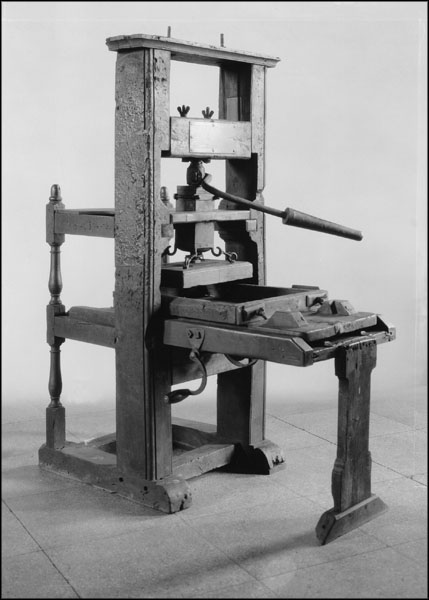
When I was 8 years old, my mom took my siblings and I on a trip around the border of the united states. We stopped in a lot of states and saw a lot of interesting things. I remember visiting a print shop that produced newspapers and being in awe of the huge machinery. Later, when I was in fourth grade, I had the opportunity to stay the night at Sutter's Mill for a field trip. One of the activities we were able to participate in while we were there was assembling our own newspaper. Well, only partially. I was able to assemble the type for my own name for trip, "Clara Greenly" and pick one out of a list of predetermined headlines to have my name inserted into. Probably the most informative part of the experience was watching how the machinery was operated and the ink applied. I still have that newspaper in a drawer somewhere back home.
Thursday, November 10, 2011
Adventures in the Life of Catherine Hawkley
Over the past two days I've kinda felt like a drug dealer. I arranged drop off meetings, one of which occurred in a deserted lobby, and transported goods from one place to another. These "goods" were actually and a page of translation we needed to create our tablet, so theses meetings were all completely legal, the setup just made me laugh.
Friday, November 4, 2011
A Brief Look at the Number Systems and Mathematics of Mesopatamia
So if Assyria had its own number system, it was not important enough for anyone to write about. As it stands, most the information about Mesopotamian number systems is about Babylonian's system, with only a little knowledge about its predecessor, Akkadian, and Akkadian's predecessor, Sumerian.
 |
| A Sumerian List of Amounts of Grain |
Friday, October 28, 2011


Friday, October 21, 2011
Akkadian
 |
| This is a letter to a king |
Friday, October 14, 2011
From oral to written knowledge and back again
So poems are one of those odd forms of expression that move
through both oral and written knowledge.
Most poems today are written down, but the structure of poetry is made
up by rhythm, alliteration, meter, breaks, etc.—all of which are only perceived
through sound and oral expression. This
is why one of my English teachers told me that poetry is meant to be read
aloud, and why there are poetry reciting competitions such as Poetry Out Loud
(I had the opportunity to participate in this in high school).

Friday, October 7, 2011
A little more about Assyria

Well, I interviewed Dr. Paul Hoskisson on Monday and quickly
arrived at the conclusion that a lot of the information in my last post is
just someone’s interpretation of the original texts. Brother Hoskisson stated “you
can’t read into texts from different places.
Assyria is different.” Some of my sources strayed from the knowledge
contained in the original texts and gather information from other societies. For example, the original texts do not specifically say that musicians were spared (although one refers to women being kept to become singers), that was just one scholar's interpretation. (Sorry Samuel)
Friday, September 30, 2011

Friday, September 23, 2011
Poison

 Okay, so who hasn’t been told “leaves of three let them
be?” I grew up with that saying and had
to remember it while walking around in my own back yard. It was knowledge passed through oral
communication, and it’s knowledge I will never forget. Along with the saying comes the
precautions. Now that you know the
saying, heed it. You are less likely to
get poison oak, if you don’t touch it.
If you seen around, even if your sure you didn’t touch it, take a cold
shower afterwards and its probably best to take a few cold showers
afterward. We take cold showers because
hot showers open up your pores and allow the irritating oil into your skin,
which can result in icky bumps or disgusting oozing messes.
Okay, so who hasn’t been told “leaves of three let them
be?” I grew up with that saying and had
to remember it while walking around in my own back yard. It was knowledge passed through oral
communication, and it’s knowledge I will never forget. Along with the saying comes the
precautions. Now that you know the
saying, heed it. You are less likely to
get poison oak, if you don’t touch it.
If you seen around, even if your sure you didn’t touch it, take a cold
shower afterwards and its probably best to take a few cold showers
afterward. We take cold showers because
hot showers open up your pores and allow the irritating oil into your skin,
which can result in icky bumps or disgusting oozing messes. All cultures have poisonous plants that they need to avoid,
but I will concentrate on the Native American tribes from what is now northern
All cultures have poisonous plants that they need to avoid,
but I will concentrate on the Native American tribes from what is now northern Thursday, September 22, 2011
Scattered thoughts on Oral Communication
Sarcasm is definitely in between oral and domestic knowledge. If you don't grow up with it, you will probably have a hard time understanding it, but you learn it purely to listening to others speak. My family uses a certain intonation when we are being sarcastic. I could demonstrate what it sounds like in person, but its impossible to communicate without inflections of speech. Just as Shuan demonstrated in class, Chinese is a language not only made up of the sounds made by consonants and vowels, but the meanings of words are also determined by the inflection used. In Chinese, a word may change from mother to horse, and in Sarcasm a statement usually becomes the exact opposite of what the vowels and consonants imply.
Friday, September 16, 2011
Assisted Learning
Well, my teaching wasn't teaching someone something for the first time, it was more helping her transfer what she already knew into slightly different forms.
Tuesday, September 13, 2011
Violin Anyone?
So this is my friend Natalie. She is pretty much amazing and a better musician than I could ever hope to be. Doesn't she have an aura of professionalism?

And this is me. I have no Idea what I’m doing and I just walked into the HFAC, BYU’s performing arts headquarters, for the first time. Deer in the headlights? I think yes.

(trying not to go cross-eyed)
This little adventure has taught a few things
- finding a quiet, secluded place to practice is next to impossible. We walked through a few floors in the HFAC and finally decided to just play in the stairwell (this provided the uncomfortable component, as I would rather not have witnesses to my embarrassment, but you do what you gotta do).
- a violin is not held perpendicular to the shoulder bone, it’s at a slight angle
- when they say rest your chin on the violin, they don’t mean lay half your face on it
- holding a violin’s bow is more complicated than holding a baseball bat, and nothing like holding a cello’s bow (my brother plays the cello, so I tried to mimic that, but it didn’t work)
- putting your finger lower on the string make the pitch higher (I already knew this in theory, but in practice, my brain died)
- It doesn’t work if you move the bow over the wrong string
- it’s difficult to differentiate strings when your crossed eyed
- even holding a violin for a few minutes makes your arm hurt because people don’t usually use the muscles in that way

(Oh look, now I'm smiling)
(My apologies, the page break icon doesn't appear on my list of icons)
Friday, September 9, 2011
Every Last Bit...
 So let’s say I’m making brownies. I pull out the box, pour
the mix in the bowl, add the oil and water, then crack
open the eggs and run my fingers along the inside to make sure all the egg white is out…. That last bit I don’t even think about. I've been doing it for so long that it is ingrained in my muscle memory, a reflex. I never thought about this simple action’s significance until my mom shared a story as part of a talk or testimony in sacrament meeting. I’ve forgotten the context in which it was shared, but I remember the details.This action that I had learned by echoing my mother, she had learned by echoing her mother, and my grandmother had learned by echoing her mother.
My great grandmother was raising several children during the great depression. They were poor and all lived in a one room shack. When they had an egg, or another food, they made sure to use all of it.
This policy of using all of something is not unique to my family (I think there’s something in the Boy Scout handbook about using anything you kill); it's a fairly common practice when resources are low.

The Plains Indians of North America lived off of buffalo. The hide was used as clothing or for shelter, in the form of tipis, the meat for food, the bones for weapons, and the list keeps going(scroll to the bottom of the page if you follow this). It was their life-force and they took what the needed and used every part of the body.
This type of folk knowledge is first acquired out of necessity, but bits and parts can linger long after the initial need has passed. Some of our odd habits have been passed down through generations, the original reasons barely remembered or completely forgotten, but the reasons are there. Ask your parents or grandparents about some of your quirky habits sometime. You might find out that they have more meaning than you thought.
Subscribe to:
Posts (Atom)