
Wednesday, November 2, 2011
Lehi in the Desert

Tuesday, November 1, 2011
Movin' Around
 |
| Going to San Diego with digital navigators is how it's done today. |
 |
| Pomponius Mela's Map from AD 43. Notice the Three Major Continents known at the time arranged in a circle |
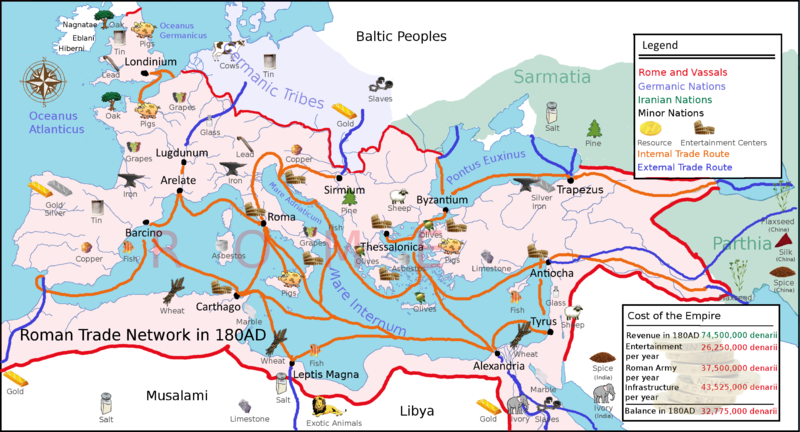 |
| Where a Roman Merchant Might Travel during the 2nd Century AD |
Now, was there tourism like there is today? According to Tony Perrottet in a National Geographic article, Augustus was a sort of its founder in the Roman Empire when he created highways and rid the Mediterranean of pirates. The favorite places were the ancient ruins of Troy in Turkey, a place immortalized by Homer's Odessey and Iliad. There was a sense among the more elite class that you weren't cultured until you had been to see where Helen was battled over, seen the great pyramids and the tombs and had these adventurous journeys. It's interesting how writing helped to create a legacy for these areas. In addition to maps, stories were a written knowledge fueling transportation by creating interest in the minds of young and old to go see what they were missing.
Written knowledge incites and motivates us to reach out to the world. It provides us with the means to arrive there by way of maps outlining what we should look for, how long to pack, what to stay clear of and what to expect when we arrive. We have built upon the knowledge of the ancients to advance the industry of transportation and tourism in a way that helps us all see the world and experience life outside of our childhood neighborhoods.
Sunday, October 30, 2011
Q & A with Dr. Toronto: A discussion on Written Knowledge
This past week I was able to interview Dr. James A. Toronto about the significance of written knowledge in the Middle East. Dr. Toronto has a Ph.D from Harvard in Islamic Studies and currently teaches at BYU.

Friday, October 28, 2011


Wednesday, October 26, 2011
The case of the Mayan codices
History has left us clues about Mayan codices. What can we find out about Mayan codices from these clues?
Parts of the writing on Mayan vases follows specific patterns which name the owner or patron of the piece and his titles. This pattern is also evident in the codices.
Additionally, some Mayan vases depict scribes making and writing on codices. We learn more about how Mayans made codices from these images.
Additionally, Spanish book-making and the Spanish alphabet took over Mayan paper- and book-making processes. The missionaries placed great importance on the printing press to make books for proselyting.
Antrhopologists Victor von Hagen and Hans Lenz in the 1940s independently observed descendants of Mayans making paper--the same way their ancestors did. They learned that paper was "bark-cloth"--a material made from tree bark fiber and solidified with oil.
There are only four Mayan codices left, and all of these are incomplete and partially deteriorated. Evidence shows that these four are probably copies, made when the condition of the originals were no longer sustainable. This suggests that Mayan codex-making is a more ancient practice than we realize.
We also learn from the surviving codices the page formatting. Long pages were folded to create many pages. The longest page of the four surviving codices measures over 22 feet, folding into 112 pages.
The Construction of the Codex...
Maya codices
Barkcloth
VASES
 |
| Mayan vase depicting scribes. (Source.) |
Additionally, some Mayan vases depict scribes making and writing on codices. We learn more about how Mayans made codices from these images.
SPANISH MISSIONARIES
Sixteenth-century Spanish missionaries in Central America deliberately destroyed codices they found. They were concerned that the presence of these books would distract the would-be converts or remind them of their "pagan past." Most codices sent back to Europe were damaged or discarded en route.Additionally, Spanish book-making and the Spanish alphabet took over Mayan paper- and book-making processes. The missionaries placed great importance on the printing press to make books for proselyting.
1940s OBSERVATIONS
 |
| Von Hagen with his wife. (And a vicuña.) (Source.) |
CODICES
 |
| A page from a Mayan codex. (Source.) |
We also learn from the surviving codices the page formatting. Long pages were folded to create many pages. The longest page of the four surviving codices measures over 22 feet, folding into 112 pages.
CONCLUSION
We still have much to learn about codices, but vases, the visitation of Spanish missionaries, modern observations, and surviving codices teach us much about the content, format, construction, and history of Mayan codices.The Construction of the Codex...
Maya codices
Barkcloth


Tuesday, October 25, 2011
Star light, star bright
 |
| Citizen AV3006-09E (Retail $1200). Can't my star disk do this too? |
The Great What if ...
As I perused through some of my favorite topics and how I might keep your attention for my limited space I jumped across at least ten topics before I was struck with that sense of 'we really have it good' in comparing today's amenities with those past. Take your wristwatch for example, how cool it would have been to show an ancient Egyptian the glow-in-the-dark button that tells you exactly what time it is. We would have glow in the dark Egyptian obelisks today! What a neat thing that they recorded numbers and data in places so that they could predict the time. Now, allow me to be your sales representative as we head off into the showroom floor and view some spectacular devices.
Subscribe to:
Posts (Atom)